


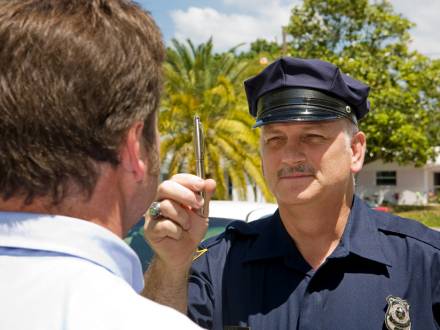
Field sobriety tests are voluntary in Maryland. You can decline them during a DUI stop without any automatic penalty to your license. These roadside exercises differ from the chemical testing covered by Maryland’s implied consent law, which carries separate refusal penalties. However, refusing the exercises does not prevent an officer from making an arrest. If you face DUI charges in 2026, our Montgomery County, MD criminal defense lawyers can review how police gathered evidence against you.
Police use three standardized field sobriety tests to check for possible impairment. During each test, officers look for certain signs of difficulty, known as clues.
The horizontal gaze nystagmus test checks for involuntary eye movements as you follow an object with your eyes. Officers look for up to six clues. The walk-and-turn test requires you to take nine heel-to-toe steps, turn around, and take nine steps back. Officers watch for eight possible clues, such as losing your balance or stepping off the line. The one-leg stand test involves raising one foot about six inches off the ground while counting aloud. Officers check for four clues, including hopping or putting your foot down.
Police can also ask you to complete other tasks, such as reciting the alphabet. However, these exercises are not part of the three standardized field sobriety tests.
You can politely decline roadside coordination exercises. Maryland's implied consent statute does not impose an automatic license suspension for refusing them. You should still provide required documents and follow lawful instructions, including an order to exit your vehicle.
An officer can consider other observations, such as driving behavior, speech, and the smell of alcohol, when deciding whether to arrest you. Refusing the exercises does not guarantee you will be allowed to leave.
A DUI case can proceed without roadside test results, but prosecutors still need evidence of impairment or another charged offense. Whether prosecutors can use a field sobriety refusal as evidence of guilt remains unsettled in Maryland. In a 2025 decision, the Appellate Court declined to decide that question. An attorney can examine whether and how the refusal affects your case.
Maryland Transportation Article § 16-205.2 addresses the handheld preliminary breath test offered before arrest. You can refuse it without the administrative penalties for refusing a later chemical test.
Officers must explain that taking or declining the preliminary test does not settle whether another test will be requested. The State cannot use the preliminary breath test result as evidence in court, although the defense can. Neither taking nor refusing that roadside test is admissible in court.
The chemical test requested later in a DUI investigation is different. Under Maryland Transportation Article § 16-205.1, refusing it can lead to a 270-day license suspension for a first refusal and two years for a later refusal. An ignition interlock option may be available. This allows you to drive with a device installed in your vehicle that requires a breath test before the engine will start. Refusal can also be introduced at trial.
Balance and coordination can be affected by factors other than alcohol. Problems with roadside testing include:
Knee, ankle, hip, or back injuries
Vertigo, neurological conditions, or other medical issues
Uneven pavement, gravel, or a sloped shoulder
Uncomfortable shoes or restrictive clothing
Poor lighting, rain, wind, or cold weather
Fatigue, nervousness, or difficulty understanding directions
Age and physical limitations can also affect performance. These factors do not automatically invalidate a test, but they may help explain why someone struggled. A poor performance alone does not prove that a driver was impaired.
Police reports describe what officers believed they observed. Body camera and dashcam video can show whether those descriptions match what happened. A lawyer can compare the recording with the officer's report and review how each test was conducted.
National testing guidelines address instructions, demonstrations, and how officers count clues. Skipped steps or incorrect scoring can weaken the evidence. A lawyer can also examine the officer's training and whether the testing location was safe and level.
Medical records, photographs, and witness statements may help explain unusual movements.
A DUI charge does not mean every roadside observation was accurate. Reviewing the tests and the officer's actions can uncover facts important to your defense. Our firm has two attorneys, and they answer the phone themselves rather than routing you through a receptionist. Our lead attorney is a lifelong Montgomery County resident. He also serves as a guest lecturer at Montgomery College and has been named a Maryland Super Lawyers honoree.
If you are facing a Maryland DUI charge in 2026, contact Diamant Gerstein, LLC at 301-560-2685 to speak with our Montgomery County, MD criminal defense lawyers today.
Se habla español. אנחנו מדברים עברית
 The use of the Internet or this form for communication with the firm or any individual member of the firm does not establish an attorney-client relationship. Confidential or time-sensitive information should not be sent through this form.
I have read and understand the Disclaimer and Privacy Policy.

6110 Executive Blvd, Suite 1050
Rockville, MD 20852


From our office in Rockville, Maryland, we serve clients throughout Montgomery County and the surrounding areas, including Ellicott City, Columbia, Frederick, Clarksburg, Germantown, Silver Spring, Chevy Chase, Olney, Bethesda, Gaithersburg, Potomac, Baltimore, Baltimore County, Prince George's County, Frederick County, Howard County, Charles County, Anne Arundel County, Kent County, Caroline County, and Washington County.
Results listed are not a guarantee or indication of future case results.

